
Identifying the Right Location to Build Small Bay Flex Warehouse vs. Self-Storage
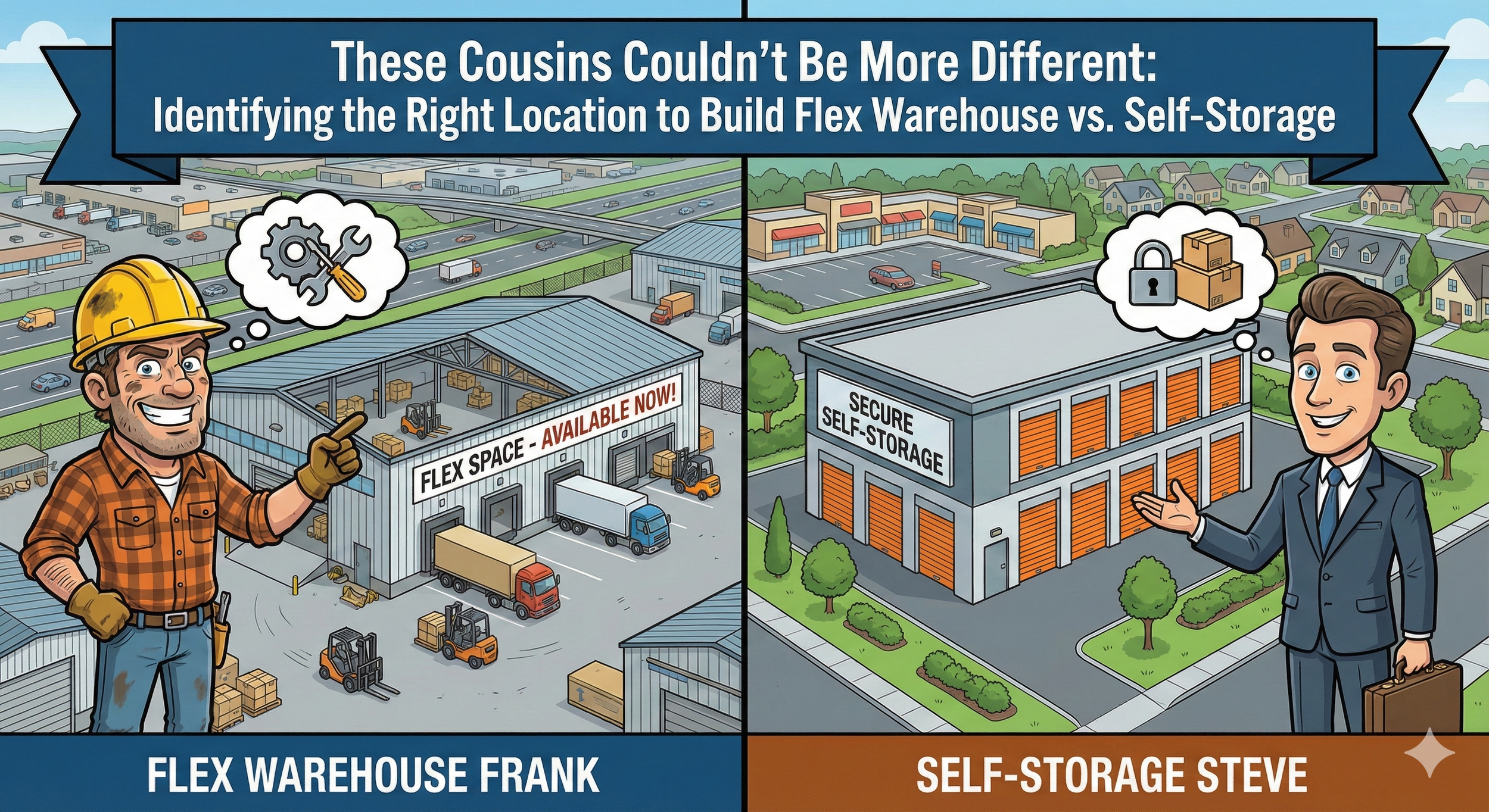
Location, Location, Completely Different Locations: Small Bay Flex Warehouses vs. Self-Storage Facilities
While both small bay flex warehouses and self-storage facilities fall under the commercial real estate umbrella, their location requirements diverge dramatically. Understanding these differences is essential for investors, developers, and operators making site selection decisions. What works brilliantly for one asset class can spell disaster for the other.
The Fundamental Difference in Purpose
Small bay flex warehouses serve as operational business facilities. Companies use them to manufacture products, fulfill orders, distribute goods, or store inventory that moves regularly through supply chains. These buildings are workplaces where employees spend full shifts, trucks make frequent deliveries and pickups, and business operations run continuously.
Self-storage facilities, by contrast, serve individual consumers and small businesses storing possessions they're not actively using. Customers visit occasionally—perhaps monthly or even less frequently—to access belongings. The facility operates with minimal staff, and visitor traffic mainly consists of passenger vehicles and a few U-Hauls rather than commercial trucks. This fundamental difference in purpose cascades into every aspect of location evaluation.
Transportation Access: Critical vs. Convenient
For small bay flex warehouses, proximity to major highways and transportation corridors represents a non-negotiable requirement. Businesses locate warehouses strategically within supply chains to minimize transportation costs and delivery times. A facility ten minutes from a major interstate interchange might command rent premiums of 20-30% over an otherwise identical building fifteen minutes farther away. Every additional mile from optimal highway access translates directly into higher fuel costs, longer driver hours, and reduced competitive positioning.
Small businesses renting flex warehouse space analyze drive times to suppliers, customers, and distribution networks. They map delivery routes, calculate fuel consumption, and model the impact of traffic patterns on operational efficiency. A business serving e-commerce fulfillment might require access within specific drive times to reach target ZIP codes for same-day or next-day delivery commitments.
Self-storage facilities prioritize visibility and convenience over transportation infrastructure. While reasonable road access matters, being adjacent to a major highway interchange offers limited advantage. In fact, properties slightly off main corridors often work perfectly well if they're visible from those routes and easily accessible. A self-storage customer driving an extra five minutes rarely reconsiders their rental decision, whereas that same distance can disqualify a warehouse location entirely.
Self-storage succeeds on secondary roads, in residential neighborhoods, and along commercial strips where land costs less than prime industrial corridors. The occasional nature of customer visits means traffic patterns and congestion matter far less. A self-storage facility thrives in locations a warehouse operator would never consider.
Visibility and Consumer Psychology
Self-storage facilities depend heavily on drive-by visibility and top-of-mind awareness. Potential customers often decide they need storage suddenly—during a move, after a life change, or when belongings overflow their home. They frequently choose facilities they've noticed during their regular commutes. Prominent road frontage, visible signage, and locations along high-traffic routes generate awareness that converts into rentals.
Developers of self-storage facilities analyze traffic counts meticulously, measuring daily vehicle passes and visibility from different approach angles. A facility hidden behind other buildings or on a street with low traffic counts faces significant marketing challenges. Many successful self-storage operators consider visibility their most valuable location attribute, sometimes outweighing other factors.
Small bay flex warehouses require no consumer visibility whatsoever for industrial and B2B tenants (though B2C tenants are the exception to this rule). Business tenants find warehouses through commercial real estate brokers, online industrial property databases, and targeted searches. A warehouse tucked into an industrial park with zero street presence functions identically to one with prominent frontage—and the hidden location often costs substantially less. Flex warehouse tenants prefer to invest in functional attributes like full HVAC, bathrooms and ceiling height rather than expensive road frontage.
Demographics and Market Analysis
Evaluating demographics for self-storage involves analyzing residential density, household income levels, homeownership rates, and housing characteristics. Facilities perform best in markets with certain profiles: growing populations, high percentages of renters (who lack storage space), affluent households (who accumulate more possessions), and areas with smaller housing units or homes without basements or garages.
Self-storage operators study population within three-to-five-mile rings around potential sites, as most customers come from nearby. They analyze life events that trigger storage needs—moving rates, divorce rates, birth rates, college student populations. Markets with transient populations or seasonal residents often support strong self-storage demand.
Small bay flex warehouse location analysis emphasizes different demographics: business types, labor force availability, wage rates, unemployment levels, and workforce skills. Small businesses need access to employees who can reach the facility for early morning or late evening shifts.
While self-storage cares about residential density, flex warehouse tenants evaluate proximity to their served markets—whether that's retail stores, distribution centers, manufacturing facilities, or end consumers. A warehouse serving last-mile e-commerce delivery analyzes population density as potential customers, not as a labor source or storage rental market.
Competitive Analysis Frameworks
Self-storage operators conduct supply studies that map existing facilities within a radius of their proposed site, calculating square feet per capita ratios. They evaluate competitors' occupancy rates, pricing strategies, and amenities. Markets with ratios below seven to nine square feet per capita often present opportunities, while oversupplied markets with ratios above ten square feet face challenges.
The competitive analysis extends to understanding how many facilities customers will pass before reaching the proposed site. Self-storage exhibits strong first-mover advantages in specific neighborhoods—the most conveniently located facility with competitive prices often wins regardless of marginal quality differences.
Light industrial warehouse competitive analysis examines entirely different factors. Operators assess industrial vacancy rates, average asking rents, and absorption trends. They analyze which logistics companies, manufacturers, and distributors operate in the market and whether supply chains are clustering in specific corridors. Rather than avoiding competition, warehouses sometimes benefit from locating near complementary businesses that create industry clusters, shared labor pools, and synergistic relationships.

Site Configuration and Physical Requirements
Small bay flex warehouses demand specific physical characteristics that limit suitable sites. Properties need sufficient depth for truck maneuvering, turning radii for tractor-trailers, and loading dock/overhead door orientations that don't conflict with parking or traffic flow. Topography matters significantly—steep grades complicate truck access and increase development costs.
These facilities require substantial power supply for lighting, HVAC, manufacturing equipment, or refrigeration. They need adequate water and sewer service, robust internet connectivity, and sometimes specialized utilities like three-phase power or natural gas. Soil conditions must support heavy floor loads from forklifts, racking systems, and stored goods.
Self-storage facilities prove far more flexible regarding site characteristics. They adapt to irregular parcels, hillside locations, and sites with unusual shapes that wouldn't accommodate warehouse truck maneuvering. Single story self-storage buildings are relatively lightweight structures without heavy floor load requirements or extensive utility needs. Some successful facilities operate in converted retail buildings, old warehouses, or purpose-built structures on sites that would never work for flex warehouse operations.
The vertical nature of modern self-storage—often three to five stories—means smaller footprints suffice in expensive urban markets. Warehouses typically require single-story construction with large floor plates, consuming more land area per square foot of usable space.
Zoning and Community Relations
Both property types face zoning considerations, but the nature of those challenges differs. Flex warehouses require industrial or commercial zoning that permits truck traffic, 24-hour operations, and business activities. Some municipalities restrict warehouse development due to concerns about traffic, noise, or aesthetic impact on residential areas. However, communities generally accept warehouses in established industrial zones without controversy.
Self-storage occupies a peculiar middle ground—neither purely industrial nor commercial retail. Residential neighborhoods often oppose self-storage facilities, viewing them as unattractive or worrying about transient activity. Yet self-storage generates minimal traffic, operates quietly, and creates little community impact compared to many commercial uses.
Paradoxically, self-storage sometimes faces stiffer neighborhood opposition despite being a better neighbor than many permitted uses. The opposition stems from aesthetics and perception rather than genuine impacts. Successful self-storage developers invest in attractive architecture, landscaping, and community engagement to overcome these concerns.
Operating Cost Structures
Small bay flex warehouses carry substantial operating costs that vary significantly by location though most are rented under a triple net lease structure. Property taxes on industrial buildings can be high, utilities consume significant budgets due to heating, cooling, and lighting large spaces, and maintenance of loading docks, HVAC systems, and industrial infrastructure requires constant attention. Labor represents the largest operational expense, making local wage rates critical to location decisions.
Transportation costs—while not strictly a property operating expense—dwarf most other considerations. A poorly located flex warehouse facility might save tenants $50,000 annually in rent while incurring $200,000 in additional transportation costs. Savvy operators evaluate total logistics costs rather than focusing narrowly on occupancy expenses.
Self-storage facilities operate with minimal staffing—sometimes just one or two employees for large facilities. Many newer developments operate virtually unstaffed, using automated access systems, online rental processes, and remote management. Utility costs stay relatively low since only common areas require climate control in many markets. The largest operational expenses are typically property taxes, marketing, and debt service rather than labor or utilities.
The great thing about flex warehouse is that it is leased on a triple net or modified gross basis, and tenants cover the operating costs. However, flex warehouse tenants still consider their total lease cost when evaluating a space.
This lean operating model means self-storage facilities tolerate less-than-ideal locations by reducing rent expectations rather than failing entirely. A flex warehouse in the wrong location simply cannot function competitively, while self-storage may adjust pricing and still operate profitably.
Growth Trajectory and Future Flexibility
Small bay flex warehouse location decisions must account for business growth, supply chain evolution, and changing logistics requirements. Companies frequently outgrow facilities or need to relocate as their markets shift. Location evaluation considers whether sites offer expansion potential, whether landlords will accommodate growth, and how easily operations could scale or relocate if needed.
The rise of e-commerce has dramatically increased demand for flex warehouses near population centers, making once-marginal locations suddenly valuable. Operators evaluate not just current supply chain needs but how trends like automation, delivery speed requirements, and inventory management practices might affect location priorities over five-to-ten-year lease terms.
Self-storage facilities, once built, rarely relocate or expand in the same way. They're designed as long-term investments with stable operations. Growth occurs through rate increases and occupancy management rather than physical expansion. Location analysis focuses on durable demographic characteristics—population density, housing stock, income levels—that remain relatively stable. While self-storage markets can become oversupplied, the underlying location attributes change slowly compared to the dynamic nature of logistics networks.
Investment Thesis and Risk Profiles
These divergent location requirements reflect different investment characteristics. Self-storage facilities typically offer stable, predictable cash flows with minimal operational complexity. Their success depends on selecting markets with strong demographics and avoiding oversupply. Location mistakes in self-storage often mean lower occupancy or rents but rarely complete operational failure.
Flex warehouse investments carry different risk-return profiles. They're operationally intensive, tenant-dependent, and vulnerable to supply chain shifts. However, they also offer potentially higher returns and appreciation in strong logistics markets. Location mistakes in warehouse development can result in prolonged vacancies or the inability to attract tenants at any viable rent level.
Making the Right Choice for Each Asset Class
Understanding these differences prevents costly mistakes. Applying self-storage location criteria to warehouse site selection—prioritizing visibility over highway access, for example—leads to functionally inadequate facilities. Conversely, evaluating self-storage sites using flex warehouse metrics misses the consumer-facing nature of the business and overlooks perfectly viable locations.
Successful location strategy requires matching each asset class to its distinct operational reality. Small businesses using flex warehouse facilities succeed through logistics efficiency, labor access, and supply chain positioning. Self-storage thrives on convenience, visibility, and serving residential markets. Recognizing these fundamental differences guides investors, developers, and operators toward location decisions that align with each property type's unique requirements and opportunities.