Building a Storage Facility on a Tight Budget: A Smart Developer's Guide
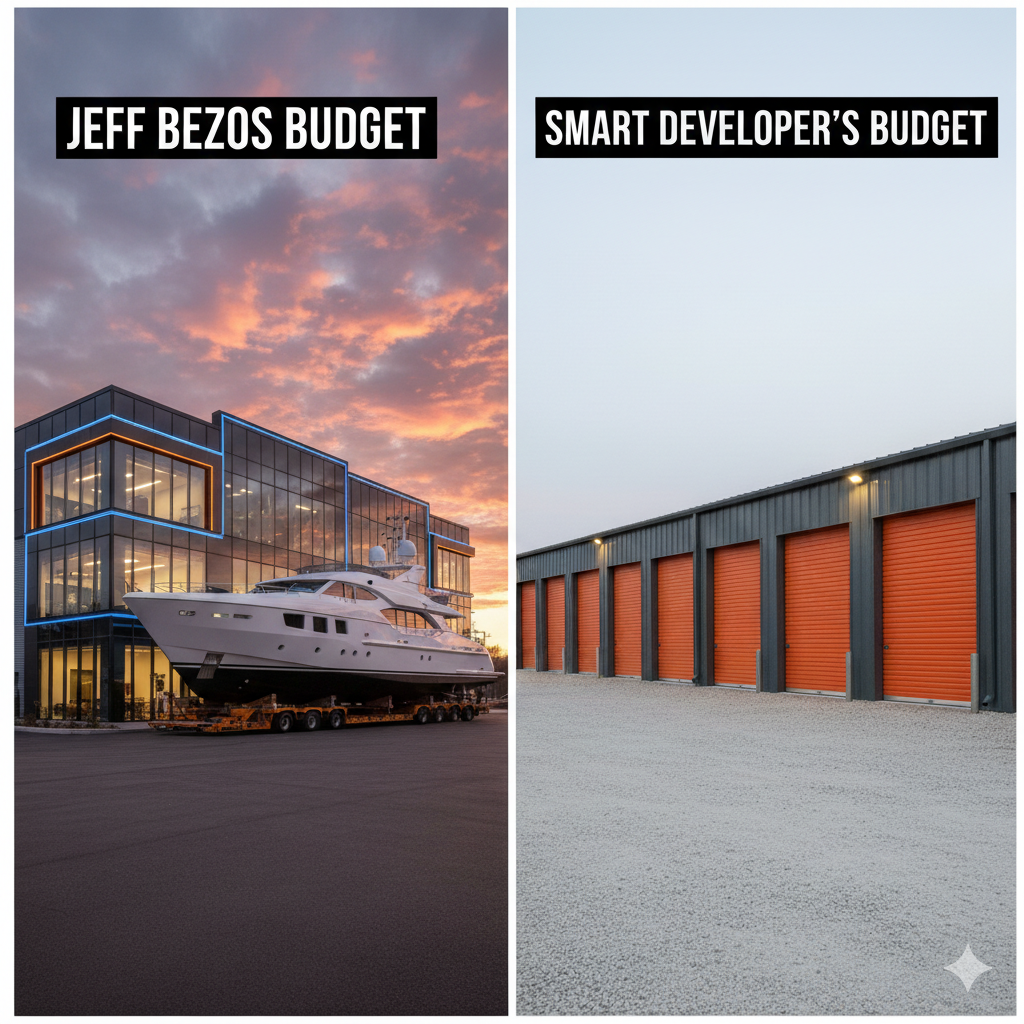
Stop Building Storage Facilities Like You're Jeff Bezos
Unless you've got Amazon money, you need a different construction strategy. Small developers can build quality self-storage and RV facilities for 30-40% less than the "industry standard" through smart material selection, phased development, and doing your own preliminary planning (yes, even if you can barely work Excel).
Building a storage facility—whether traditional self-storage or boat and RV storage—doesn't have to break the bank. With strategic planning and disciplined execution, small developers can create profitable, quality facilities without the bloated budgets that plague many projects. Here's how to maximize every dollar while building an operation that will serve your market for decades.
Why Building During a Down Cycle Makes Sense
While it may seem counterintuitive, economic downturns often present the best opportunities for storage development. Construction costs typically decline as contractors compete for fewer projects, material prices soften, and labor becomes more available. It's the real estate equivalent of buying winter coats in July—everyone thinks you're crazy until you're the one staying warm while saving money.
Developers who build during these periods benefit from lower all-in costs while positioning themselves to capture demand when the economy recovers. Additionally, storage facilities tend to be recession-resistant. During economic uncertainty, people downsize homes, businesses reduce office space, and consumers look for affordable places to store belongings and vehicles. A facility that comes online during or just after a downturn can capture this demand while enjoying lower construction costs—a powerful combination for long-term profitability.
Start with Smart Site Planning
Before you hand over tens of thousands of dollars to architects and engineers, do your homework. Modern design tools make it possible to create preliminary site layouts yourself. Programs like SmartDraw, Cedreo, and even Canva offer user-friendly interfaces that don't require an engineering degree to navigate. If you're more technically inclined (or just a glutton for punishment), AutoCAD and SketchUp remain solid options for luddites who prefer the old-school approach.
For self-storage, these tools help you visualize building placement, unit configurations, and traffic flow. For boat and RV storage, focus on maximizing linear footage while maintaining appropriate drive aisle widths—typically 35-40 feet for RV storage to allow comfortable maneuvering. (Trust me, watching someone try to back a 40-foot Class A motorhome into a 30-foot aisle is entertainment nobody needs.)
Here's a secret many developers miss: many metal building manufacturers offer free or low-cost preliminary site plans. They'll even build the cost of the structural plans into your overall construction budget, essentially giving you professional design work without the upfront cash outlay. It's like getting an appetizer with your meal instead of paying separately—why wouldn't you take advantage of it?
By arriving at your engineer or architect's office with a well-thought-out preliminary plan, you'll spend less time (and money) on revisions. One developer in Texas reported saving over $15,000 in architectural fees by presenting a detailed site concept that only needed professional refinement rather than starting from scratch.
Value-Engineer Your Construction Approach
The biggest budget killer for small developers is hiring expensive general contractors for projects that don't require them. For boat and RV storage facilities, which are often simpler structures with paved lots, security fencing, and covered or enclosed spaces, consider managing subcontractors directly or hiring a construction manager who works for a fee rather than a percentage markup.
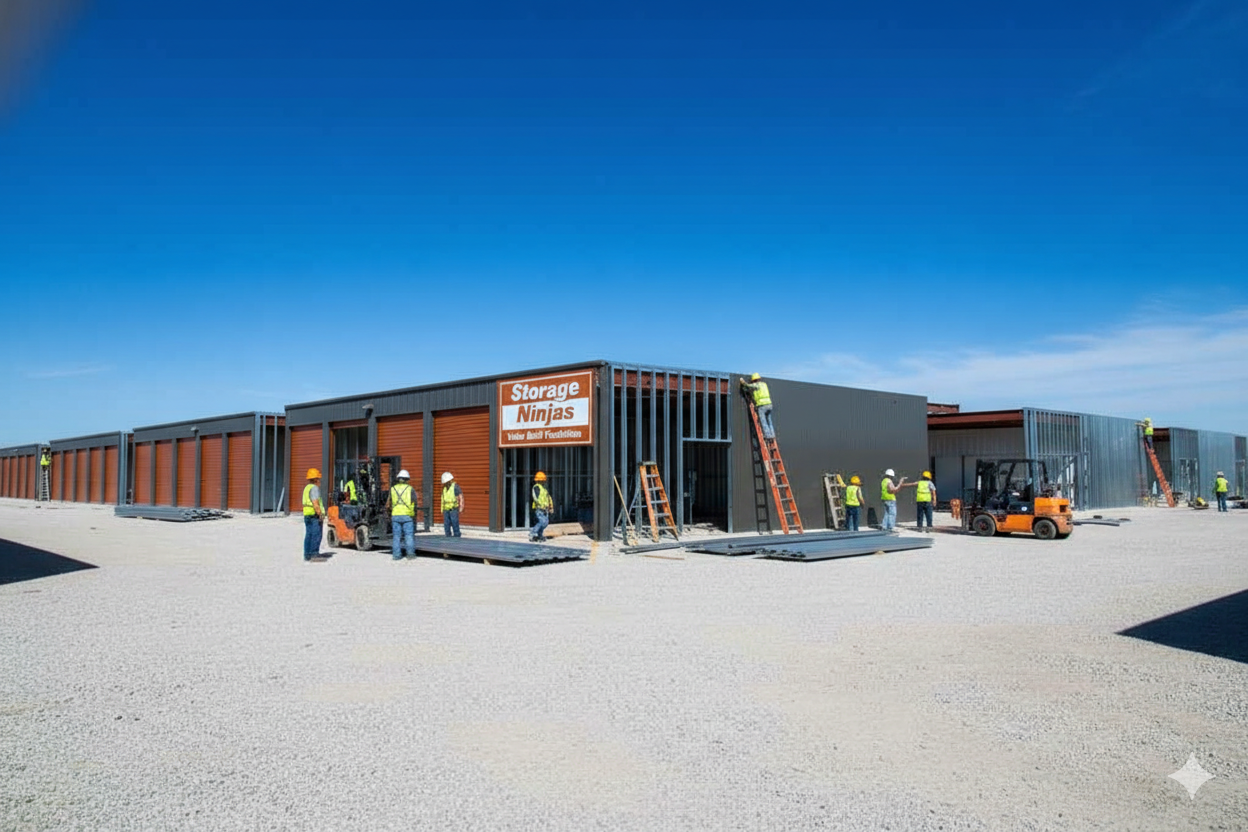
Self-Storage Construction Savings:
Compare metal buildings to tilt-up construction—metal buildings typically run 20-40% cheaper for small to mid-size projects (under 100,000 square feet), with costs around $10-20 per square foot for framing versus $25-40 per square foot for tilt-up. At very large scales, tilt-up can become competitive, but most small developers won't reach those sizes on their first project.
Consider single-story designs to eliminate elevator costs and structural complexity
Use standard unit sizes (10x10, 10x20) to simplify construction and maximize efficiency
Plan to delay climate control as a future phase until you've proven market demand and generated some revenue
Look for pre-engineered building systems designed specifically for self-storage
Source doors and hardware directly from manufacturers rather than through contractors
Use LED lighting from the start—higher upfront cost but dramatically lower operating expenses (and you'll thank yourself when the electric bill arrives)
Boat & RV Storage Construction Savings:
Start with uncovered parking spaces, then add canopies or enclosed units as revenue allows
Use compacted aggregate base with chip seal surfacing instead of full-depth asphalt initially
Install basic chain-link fencing first, upgrading to decorative fencing in phases or at the entrance only
Consider used shipping containers for small enclosed storage at a fraction of traditional building costs (bonus: they're basically indestructible)
Build simple pole-barn style covered structures instead of engineered canopies
Design wider spaces (12-14 feet) that can accommodate multiple vehicle types, increasing flexibility
· Use concrete wheel tracks instead of full-width paving for covered areas—pave only two parallel strips (about 2-3 feet wide each) where the vehicle's wheels will sit, leaving gravel or compacted dirt between them. This can cut your paving costs in half while still providing stable support. For example, instead of paving a full 12' x 45' space (540 sq ft), you'd only pave two 2.5' x 45' strips (225 sq ft). Note that this approach works best for budget-conscious facilities; premium operations targeting high-end customers should opt for full-width paving for a more polished look
Material Selection: Quality vs. Cost
Building on a budget doesn't mean compromising on quality where it matters. Focus your spending on elements that affect long-term durability and customer experience:
Worth the Investment:
Standing seam roofs: Yes, they cost more upfront ($12-16 per square foot versus $3.50-8 for screw-down metal roofs), but here's the thing about screw-down roofs that contractors conveniently forget to mention: those exposed screws back out over time as the metal expands and contracts, the neoprene washers deteriorate, and suddenly you're re-screwing your entire roof every 15-20 years. Standing seam roofs last 30-50 years (up to 70 with proper care) compared to 20-30 years for screw-down, and the hidden fastener design means no penetrations through the metal to leak. You'll also save on energy costs thanks to their reflective properties. The real question isn't whether you can afford standing seam—it's whether you can afford to re-roof your facility multiple times because you went cheap on Day One.
Proper site drainage and grading—fixing water issues later costs triple the initial investment
Commercial-grade door hardware and locks
Adequate concrete thickness (4-6 inches with proper base for self-storage, 6-8 inches for RV storage to handle heavy vehicles)
Underground utilities properly sized for future expansion
Where You Can Save:
Basic landscaping initially (you can enhance curb appeal over time)
Office finishes (you can upgrade as revenue allows)
Decorative fencing elements
Non-essential amenities like covered walkways between buildings
Premium exterior colors (standard colors from metal building manufacturers cost less)
Strategic Subcontractor Selection
During economic downturns, you have leverage with subcontractors. Get multiple bids for every trade and don't be afraid to negotiate. Many contractors will sharpen their pencils to keep their crews working. It's a buyer's market—use it.
Money-Saving Tactics:
Bundle multiple phases with the same contractor for volume discounts
Provide your own materials for certain trades (especially doors, gates, and hardware)
Schedule work during contractors' slow seasons
Consider newer, hungrier contractors who deliver quality work at lower rates to build their reputation
For RV storage paving, get bids from both asphalt and concrete contractors—depending on your market, one may be significantly cheaper
Pull your own permits and handle inspections yourself (if you have the experience to know what you’re looking at) to save on GC administrative fees
Budget Realistically for Essential Infrastructure
Many developers excel at budgeting for buildings but fail to account for the costs that make a facility actually function. These aren't luxuries—they're necessities that directly impact your ability to lease up and operate efficiently.
Often-Overlooked Capital Expenditures:
Proper drainage systems and retention ponds (required in most jurisdictions, and discovering this mid-construction is a special kind of budget nightmare)
Adequate lighting for security and 24/7 access
Technology infrastructure (gate systems, cameras, management software)
Signage—both on-site wayfinding and road visibility
Office setup with proper HVAC, restroom, and workspace
Pavement maintenance reserves (especially crucial for RV storage with heavy vehicle traffic)
Fire suppression systems if required by local code
Set aside 10-15% of your construction budget for these items. Discovering you need a $30,000 retention pond after you've exhausted your budget can derail an entire project.
Phase Your Development Strategically
Just because you have land for 500 self-storage units or 200 RV spaces doesn't mean you should build them all at once. Phased development reduces initial capital requirements and allows you to adjust your product mix based on actual market demand. Think of it as the "try before you buy" approach to large-scale development.
Self-Storage Phasing Example:
Phase 1: Build 150-200 units of drive-up storage with basic office and security infrastructure
Phase 2: Add climate-controlled units in a single-story (Sensei’s favorite: drive-up climate-control) or multi-story building based on demand patterns
Phase 3: Expand with specialty units (wine storage, vehicle storage) as market dictates
Boat & RV Storage Phasing Example:
Phase 1: Grade and pave for 50-75 uncovered spaces with perimeter fence and basic gate
Phase 2: Add covered canopy spaces based on customer willingness to pay premium
Phase 3: Build enclosed units or add wash bay facilities for additional revenue
This approach reduces your initial capital outlay and allows you to validate market demand before committing to full buildout. It also helps with cash flow, as Phase 1 revenue can help fund Phase 2 construction. Plus, if you completely misjudged the unit mix, you can pivot.
Site Work: Where Big Money Gets Spent (or Saved)
Site work often represents 20-30% of total project costs and is where inexperienced developers frequently overspend.
Site Work Savings Strategies:
Choose flatter sites to minimize grading costs (every foot of cut or fill adds expense, and Mother Nature charges by the cubic yard)
Locate buildings to balance cut and fill on-site rather than hauling dirt
Understand soil conditions before you buy—poor soils requiring deep remediation can double your foundation costs
For RV storage, consider pervious paving options that reduce stormwater requirements
Negotiate to keep topsoil on-site for landscaping rather than hauling it away and buying it back (yes, this happens more often than you'd think)
Time earth work for dry seasons to avoid mud delays and extra compaction costs
Design your facility to work with natural drainage patterns rather than fighting them

Avoid These Common Budget Busters
Overly Complex Designs: Every architectural flourish costs money. Keep buildings simple and functional. Your customers care about clean, secure, well-lit units—not decorative cupolas or fancy facades. Save the architectural magazine cover shot for your second phase when you're flush with cash.
Underestimating Utility Costs: Running power, water, and sewer to a remote site can cost $50,000-$150,000. Verify utility availability and connection costs before purchasing land. "We'll figure it out later" is not a viable utility strategy.
Ignoring Soil Reports: A $3,000 geotechnical study can reveal $100,000 in foundation problems. Never skip this step. Ever. Seriously.
Building Too Much Too Soon: A half-full facility with debt service on 300 units performs worse than a full facility with debt service on 150 units. It's basic math, but you'd be surprised how many developers fail this test (did I mention you should always get a feasibility study and sometimes you might want to have two?).
Wrong Unit Mix: For self-storage, the 10x10 unit is the industry workhorse. For RV storage, ensure your spaces accommodate Class A motorhomes (45+ feet) if that's your market. Building what you think people want instead of what they actually rent is an expensive mistake. Your feasibility consultant and an experienced site plan designer that specializes in storage will save you a lot of money here.
Underwrite Conservatively
The fastest way to budget disaster is optimistic financial projections. Use conservative assumptions:
Construction costs: Add 15-20% to contractor estimates for overruns and changes
Lease-up pace: Assume a minimum 18-24 months to stabilization, not 6-12 months
Rental rates: Use current market rates minus 5-10%, not "projected" rates
Occupancy: Underwrite to 85-90% stabilized occupancy, not 95%+
If your project doesn't pencil with conservative numbers, it's not a viable project on a tight budget. Be willing to walk away from deals that only work with best-case scenarios. Your future self will thank you.
Know When to Spend
Budget discipline doesn't mean being cheap in the wrong places. Invest appropriately in:
Quality security systems: Cameras, lighting, and fencing pay for themselves in reduced insurance costs and fewer incidents. For boat and RV storage in particular, customers are storing $50,000-$500,000 assets and expect robust security. Skimp here and watch your reputation (and customer base) evaporate.
Proper paving and drainage: This is your foundation. Trying to save 10% on paving will cost you 300% when you have to tear it out and redo it in three years. Ask any developer who's been through a paving nightmare—they'll all tell you the same thing while staring into the distance with haunted eyes.
Code compliance and permitting: Cutting corners here leads to costly retrofits, stop-work orders, or facilities that can't get occupancy permits. Building inspectors have long memories and zero sense of humor about violations.
Quality roll-up doors: Cheap doors fail frequently, create service headaches, and frustrate customers. Mid-grade commercial doors last longer and operate better. The $50 you save per door will cost you $500 in service calls and lost customers.
The Bottom Line
Building a storage facility on a tight budget requires discipline, creativity, and a willingness to do more work yourself. By value-engineering your construction, phasing your development, selecting materials strategically, and budgeting realistically for all necessary expenses, you can build a quality facility without the inflated costs that plague many small developers.
Economic downturns offer unique advantages: lower construction costs, better contractor availability, and less competition from other developers. While others sit on the sidelines waiting for "perfect" market conditions, smart developers can build high-quality facilities at reduced costs, positioning themselves to capture demand as markets recover.
Remember: the goal isn't just to build cheaply—it's to build smartly. Every dollar saved in unnecessary expenses is a dollar that flows to your bottom line, accelerating your path to profitability and building equity in a hard asset that will generate income for decades to come. Build it right, build it lean, and watch your investment compound over time.